
Brush your hand against a lemon balm plant and you’ll immediately understand why it earned its name. The leaves release a bright, unmistakably lemony scent the moment they’re touched, even though the plant itself isn’t related to citrus at all — it’s actually a member of the mint family. This fresh, uplifting fragrance, paired with a long history of use in traditional herbal practices, has made lemon balm one of the most popular calming herbs in tea blends around the world, valued as much for its comforting aroma as for the sense of ease many people associate with it.
Lemon balm (Melissa officinalis) is native to the Mediterranean region and parts of Central Asia, though it has since spread and naturalized in gardens across Europe, the Americas, and beyond. Its Latin name, Melissa, comes from the Greek word for “honeybee,” a reference to how strongly the plant’s flowers attract bees — in fact, lemon balm has historically been planted near beehives to encourage healthy pollination. The plant itself is a hardy, leafy perennial, easy to grow, and it has been cultivated in herb gardens for centuries, prized for both its fragrance and its versatility.
Historically, lemon balm held an important place in traditional European herbalism, where it was often included in aromatic waters, tonics, and infusions meant to be calming and refreshing. Its bright, citrusy character made it distinct from other calming herbs of the time, offering a lighter, more uplifting note compared to the deeper, earthier flavors of herbs like valerian. Over generations, lemon balm developed a reputation as a “cheerful” herb — one associated with lifting the spirits as much as settling them.
A Herb Traditionally Linked to Ease and Calm
In traditional herbal practice, lemon balm has long been associated with soothing a busy or overactive mind, and it’s often reached for during moments that call for a bit of steadiness — before bed, during a stressful stretch of the day, or simply as part of a calming afternoon pause. Many people describe lemon balm tea as having a gently uplifting yet relaxing quality, a combination that makes it distinct from purely sedative herbs. It’s this dual character — bright and calming at once — that has kept lemon balm a staple in herbal tea cabinets for generations.
It’s worth being clear that these associations come from long-standing herbal tradition and popular use rather than from medical claims; lemon balm is not a treatment for any condition, and it shouldn’t be used as a substitute for professional care. That said, the ritual of sipping a warm, lemon-scented tea in the evening is, for many people, simply a pleasant and comforting way to signal to the body and mind that it’s time to slow down.
Lemon balm’s mild, citrusy flavor also makes it a favorite for blending. It pairs naturally with other calming herbs, softening stronger floral notes like lavender while adding brightness to earthier ingredients like pandan. This versatility is part of why lemon balm shows up so often in bedtime tea blends — it acts almost like a bridge, tying together the other flavors in the mix into a smoother, more rounded cup.
Brewing Lemon Balm and Building an Evening Ritual Around It
To brew lemon balm tea well, use water just off the boil, around 90 to 95°C, and steep dried lemon balm leaves for about 5 to 10 minutes depending on how strong you like your tea. Because the leaves are relatively delicate, over-steeping can occasionally dull the bright citrus notes, so shorter steeping times tend to preserve the fresher, more vibrant character of the herb. Fresh lemon balm, if you have access to a plant, can also be steeped for an even more vivid, garden-fresh cup.
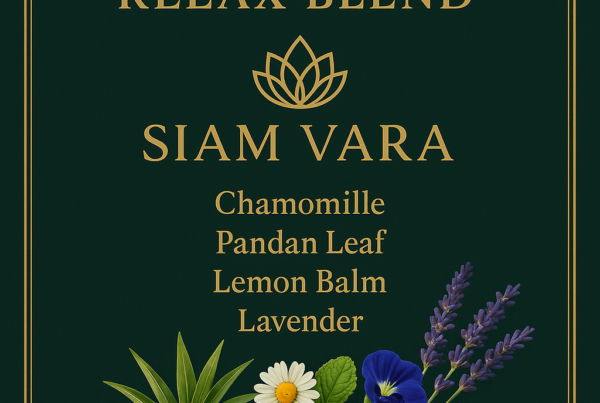
Lemon balm is naturally caffeine-free, making it a comfortable choice for an evening cup without concerns about disrupting sleep patterns the way caffeinated teas might. Many people enjoy it on its own, letting the citrusy aroma take center stage, while others prefer it blended into a broader herbal mix alongside chamomile, pandan, butterfly pea, or lavender — a combination found in evening blends such as Siam Vara’s Sleep & Relax pyramid tea bags, where lemon balm’s brightness helps balance the deeper floral notes of the other herbs.
As part of a wind-down routine, lemon balm tea works well alongside other calming habits: turning off screens, dimming the lights, or simply sitting quietly for a few minutes while the tea steeps. The bright citrus aroma rising from the cup can itself feel like a small, pleasant marker that the busyness of the day is being set aside, even before the first sip is taken.